Methi Seeds: Mere Kitchen Staple or a Powerful Herb?

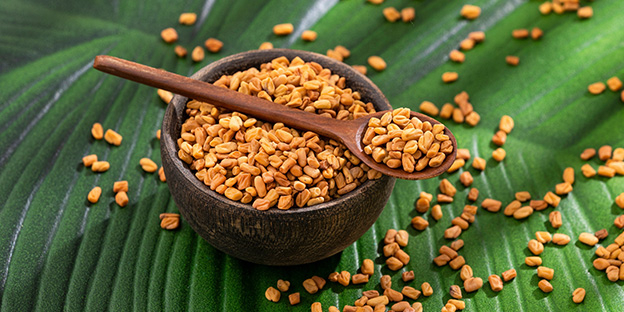
Open a spice box in an Indian kitchen and you will probably find them.
Small. Golden-brown. Slightly bitter.
Methi seeds.
We know them as methi dana. They appear in pickles, curries, spice blends and home remedies. Some people soak them overnight and drink the water in the morning. Others roast them before adding them to food.
But fenugreek has a much bigger story than its place in an Indian kitchen.
Its scientific name is Trigonella foenum-graecum, and the plant has been used as both food and traditional medicine for thousands of years. The seeds have a distinctive smell and a slightly maple-like flavour, and historical use of the plant stretches across several cultures.
So why has this tiny seed remained so popular?
And what happens when some of its traditional claims meet modern research?
Let’s take a closer look.
1. Methi Is Older Than Your Kitchen
Fenugreek is believed to have been used medicinally for around 6,000 years.
That does not mean everything traditionally said about it has been scientifically proven. It does, however, tell us something interesting about the plant’s history.
People have used fenugreek as a food, spice and traditional remedy in different parts of the world.
In traditional Indian practices, methi has been used in preparations associated with digestion, general nourishment and other health concerns.
Its seeds are particularly interesting because they contain dietary fibre and compounds such as saponins and alkaloids.
A notable component: Galactomannan
The seeds contain galactomannan, a type of soluble fibre that can absorb water and form a viscous substance. This property may help explain why fenugreek has attracted modern scientific interest.
A traditional ingredient suddenly becomes a subject for researchers asking a very modern question:
Could some of its physical and chemical properties actually influence health?
2. Why Does Methi Taste So Bitter?
If you have ever bitten into methi seeds, you probably already know the answer.
They’re bitter.
But that bitterness is part of what makes fenugreek fascinating.
Fenugreek contains numerous naturally occurring compounds, including steroidal saponins, alkaloids and polyphenols. Its composition can vary depending on factors such as cultivation, processing and preparation.
One of its best-known compounds is 4-hydroxyisoleucine, which has been studied for its possible relationship with glucose and insulin metabolism.
A useful rule when reading herbal research
A compound having an interesting effect in a laboratory does not automatically mean eating the whole plant produces the same effect in humans.
Human trials are needed to answer that question.
And fenugreek has been studied in humans.
3. Methi and Blood Sugar: An Interesting Research Trail
Fenugreek is frequently promoted as a natural way to manage blood sugar.
There is some research behind the interest.
Clinical studies have investigated fenugreek preparations in people with type 2 diabetes and other metabolic conditions. Some studies have reported improvements in blood glucose measurements.
A 2023 systematic review and meta-analysis of randomised controlled trials also examined fenugreek in type 2 diabetes and prediabetes.
What the evidence suggests
The evidence is not strong enough to turn fenugreek into a replacement for established diabetes treatment.
The U.S. National Center for Complementary and Integrative Health (NCCIH) currently states that although research suggests fenugreek may help lower blood sugar, many studies have important quality limitations, and there is not enough high-quality evidence to determine its usefulness for diabetes.
That’s an important distinction.
“May help” is not the same thing as “proven treatment.”
4. What About Digestion?
This is perhaps one of the most natural ways to think about methi.
The seeds contain fibre, and fibre is important for normal digestive function.
Fenugreek has traditionally been used as a laxative and digestive ingredient in different cultures.
But again, tradition and clinical evidence need to be kept separate.
The fact that a food contains fibre does not mean taking large quantities will automatically improve everyone’s digestion.
In fact, consuming too much fenugreek may cause digestive symptoms such as diarrhoea, nausea or other gastrointestinal discomfort.
Sometimes the simplest lesson is also the most useful:
A little of an ingredient used as food and a concentrated supplement are two very different things.
5. Why Do People Soak Methi Seeds?
This is one of those household practices that has become almost routine in some families.
Methi seeds are soaked in water, often overnight, and the seeds or soaking water are consumed the following morning.
But does soaking magically unlock a special health effect?
What we can say with confidence
There isn’t enough good evidence to make that claim. Soaking changes the physical characteristics of the seeds and can make them softer and easier to consume. It may also affect some of their compounds.
But there is no established scientific rule saying that methi water is inherently superior to eating the seeds as part of food.
If you enjoy the tradition, that’s one thing.
Presenting it as a scientifically proven treatment for diabetes, weight loss or another disease would be another.
6. Methi and Breastfeeding: Another Traditional Claim
Fenugreek has traditionally been used to try to increase breast milk production.
This is another area where popular belief has moved faster than the evidence.
Some studies have investigated fenugreek as a galactagogue, meaning a substance intended to increase milk production.
The results have been mixed.
NCCIH currently says that it is uncertain whether fenugreek actually increases milk supply and that more high-quality research is needed.
Important safety consideration
Fenugreek is not considered safe during pregnancy in amounts greater than those normally found in food, and it has been associated with increased birth-defect risk.
So a traditional use should never be interpreted as a blanket recommendation for everyone.
7. Methi as Food May Be the Simplest Story
There is something refreshing about looking at methi as a food first.
You don’t necessarily need a complicated routine.
Methi seeds can add bitterness, aroma and depth to cooking. The leaves have their own culinary role, while the seeds are used in pickles, curries and spice mixtures.
The seed also provides fibre and other naturally occurring plant compounds.
Food does not have to become medicine before it becomes valuable.
And perhaps that is where many traditional ingredients make the most sense.
Is Methi Safe?
Fenugreek is generally considered safe in the amounts commonly found in food.
Larger amounts may cause side effects such as diarrhoea, nausea and other digestive symptoms. It can also cause allergic reactions in some people.
Because fenugreek may affect blood sugar, people taking diabetes medication should be particularly cautious about using concentrated preparations.
Herb-drug interactions are another reason to discuss supplements with a healthcare professional.
Pregnancy deserves special attention: medicinal or supplement-level quantities should be avoided unless specifically advised by a qualified healthcare professional.
Frequently Asked Questions
Is methi the same as fenugreek?
Yes. Methi is the common Indian name for fenugreek. The seeds come from Trigonella foenum-graecum.
Can methi lower blood sugar?
Some research suggests it may, but the evidence is not strong or consistent enough to consider fenugreek a proven diabetes treatment.
Is soaked methi water scientifically proven to be beneficial?
There isn’t enough evidence to say that soaking fenugreek seeds and drinking the water provides special health benefits compared with other forms of consumption.
Can pregnant women take methi supplements?
Medicinal amounts of fenugreek are not considered safe during pregnancy. Normal food quantities are a different matter, but concentrated preparations should be discussed with a healthcare professional.
Why are methi seeds bitter?
Their bitterness comes from their naturally occurring plant compounds. It is one of the characteristics that gives fenugreek its distinctive culinary and traditional identity.
The Takeaway: A Tiny Seed With a Very Long Memory
Methi seeds are easy to overlook.
They’re small enough to disappear into a spice box and familiar enough that we rarely question where they came from.
Yet this little seed has travelled through thousands of years of food traditions and traditional medicine.
Modern science has found plenty of reasons to study it, particularly its fibre and other biologically active compounds. Some findings are promising. Others remain uncertain.
Methi doesn’t need to be a miracle seed to be worth knowing.
It can simply be an ancient food, a fascinating plant, and an example of how traditional knowledge can give modern science questions worth investigating.
The next time you see those tiny golden seeds in your kitchen, you might look at them a little differently.
Sometimes, the most interesting history is hiding in the smallest things.
References & Further Reading
- National Center for Complementary and Integrative Health (NCCIH). Fenugreek: Usefulness and Safety.
- NCCIH. Women’s Health and Complementary Approaches.
- Kim J, Noh W, Kim A, et al. The effect of fenugreek in type 2 diabetes and prediabetes: a systematic review and meta-analysis of randomized controlled trials. International Journal of Molecular Sciences, 2023.
- Visuvanathan T, Than LTL, Stanslas J, et al. Revisiting Trigonella foenum-graecum L.: pharmacology and therapeutic potentialities. Plants, 2022.
Disclaimer: This article is for educational purposes only and is not medical advice. Traditional uses described here should not be interpreted as proven treatments. If you have a medical condition, are pregnant or breastfeeding, or take medication, consult a qualified healthcare professional before using fenugreek in concentrated or supplement forms.
“`